I mapped every possible photo source for my app, here are the survivors
Instagram Basic Display is dead, WhatsApp is closed by design, Facebook still holds. The real landscape of photo imports for a mobile app in 2026.
My app needed to import its users' photos. Obvious starting point: "we'll plug in Instagram, WhatsApp, Facebook, Google Photos". Three weeks of documentation later, the real map looks nothing like what we imagined.
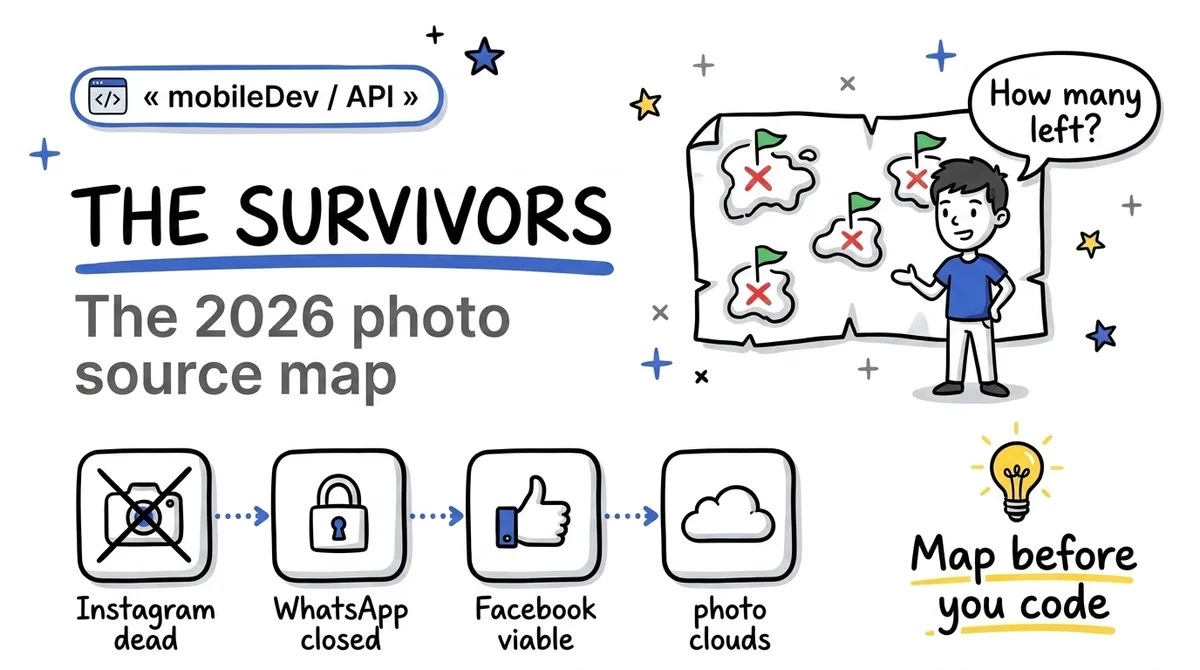
This post frames a small series on photo integrations. Here is the landscape, source by source.
Instagram: dead for good
The Instagram Basic Display API, the one that let a third-party app read a consenting user's photo library, was shut down in December 2024. Not deprecated: shut down.
What remains goes through the Instagram API on Graph, restricted to business and creator accounts, designed for content management rather than consumer imports. For the "my regular user wants to pull their Instagram photos" case, the honest 2026 answer: there is no official path anymore.
WhatsApp: closed by construction
WhatsApp never had a consumer media API, and structurally never will: end-to-end encryption means media only exist in clear form on devices. No OAuth, no server-side photo library to query.
The only way to a user's WhatsApp photos is the phone's local storage, through the OS media permissions. That is not a WhatsApp integration, it is a gallery import that happens to pick up the WhatsApp folder.
Facebook: the survivor nobody expected
The Graph API still exposes user photos through the user_photos permission, App Review required. The review process is heavy and the permission must be justified by a real, visible use case in your app, but the path exists and works. The user_photos docs even explicitly mention the photo book / printing use case: if that is your business, you are inside the intended frame.
Irony of history: the platform with the closed reputation is today the only social source you can still integrate cleanly.
Photo clouds: the real survivors
Google Photos (through the Picker API, session-based: the user selects, the app fetches), OneDrive, Dropbox: all three expose usable APIs to read photos with the user's OAuth consent. That is where photos live in 2026, and that is where integration effort pays off. Add Flickr for photographers, with one subtlety: the commercial key is required as soon as your app is paid.
And the structural absentees, to settle product meetings once and for all: TikTok, Snapchat, BeReal and Pinterest are incompatible by architecture. Ephemeral content, video-first or no media API: no photo library import flow exists there.
But each has its traps, juicy enough to deserve their own posts:
- Google Photos and OneDrive have exactly opposite requirements on the same HTTP header (next post in the series).
- Dropbox breaks on the first accented filename unless you know one precise escaping rule.
- And the token broker question (do you need a Cloud Function between the app and these APIs?) deserves a more honest answer than the tutorials give.
Takeaways
- Never assume a photo source can be integrated: half of the 2020 map is gone.
- Consumer third-party Instagram: over since December 2024. WhatsApp: never existed, by design.
- Facebook (
user_photos+ App Review) and the photo clouds (Google Photos, OneDrive, Dropbox) are the survivors. - Map the sources before writing the first integration line: it costs three weeks of docs, it saves promising an impossible feature.
Which photo source do your users ask for the most?